
After an eventful finish to the Azerbaijan Grand Prix, Formula 1 moved to its next host destination. From the Baku Street F1 circuit, the F1 paddock headed to the Sepang International Circuit. However, the next destination was meant to be the Bahrain International Circuit, but due to the ongoing war and tense movements in the Middle East, the Sepang F1 circuit became the perfect replacement for Bahrain Grand Prix.
Well, this meant F1 was back in Malaysia after 9 long years since it last raced in 2017. For the 2026 edition, the Malaysian GP will be known as the Bahrain Grand Prix of Malaysia, as all the event planning and management are to be handled by the Bahrain GP officials. The Malaysian fans will once again witness the roar of modern hybrid power units echo around Sepang International Circuit.
For enthusiasts who grew up watching Schumacher, Vettel, and Alonso battle in the tropical heat, it feels like a homecoming with a twist. In this article, we delve into the history of the Sepang International Circuit and also share records and facts about the infamous Malaysian Grand Prix, which hosted its first F1 event in 1999.
History of the Malaysian Grand Prix
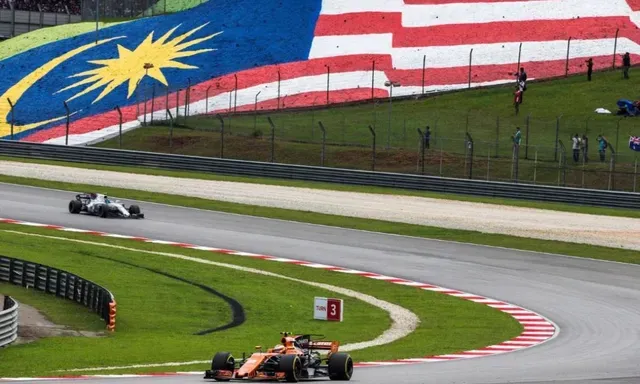
The Malaysian Grand Prix was one of Formula 1’s most popular racing circuits in South Asia. Designed and developed as a modern Herman Tilke-themed circuit with some of the toughest and most strategic physical challenges in the FIA World Formula 1 championship.
The Malaysian Grand Prix was a part of the F1 World Championship races from 1999 to 2017. Its first inaugural Malaysian F1 race was held in 1999 at the Sepang International F1 circuit. The inaugural race was formally known as the 1999 Petronas Malaysian Grand Prix, which took place on October 17. The Sepang F1 track became known for its dramatic weather, high tyre wear, and pivotal role in several championship battles.
By the mid-2010s, the Malaysian Grand Prix remained popular with teams and drivers but faced commercial challenges. Ticket sales were decreasing year after year, and the cost of hosting a F1 race grew harder to justify against newer, higher-paying venues.
During its final year in 2017, the 2017 Malaysian GP proved to be the last. Max Verstappen took victory for Red Bull, his second career win. On the other hand, Sebastian Vettel set the fastest lap record, which can be broken in the 2026 edition.
After 19 consecutive runs between 1999 and 2017, the Malaysian Grand Prix was dropped from the calendar, with rumours of its demise circulating as early as 2016. Even without F1, Sepang remained an important regional hub, continuing to host motorcycle racing, endurance events, and other international series.
History and Stats of the Sepang International Circuit
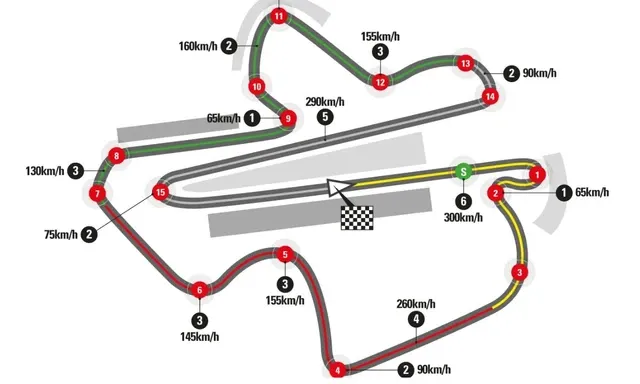
The construction of the track began in 1997. The track was designed by the famous German designer Hermann Tilke, who had already designed circuits for the Shanghai GP, Marina Bay Singapore Grand Prix, and Yas Marina Circuit. Sepang first joined the F1 calendar in 1999, quickly becoming a fixture thanks to its dramatic architecture, challenging layout, and relentless climate.
Circuit Name | Sepang International Circuit |
Circuit Certification | FIA Grade 1 License |
Circuit Length | 5.543 km |
Race Distance | 310.408 km |
No. of Laps | 56 |
Turns | 15 |
First Grand Prix | 1999 (Malaysian Grand Prix) |
Last Grand Prix | 2017 |
Fastest Lap Record | 1:34.080 secs (Sebastian Vettel, 2017) |
DRS Zones | 2 |
Talking about the stats, Sepang traditionally covered 56 laps over the 5.543 km Grand Prix layout, totalling 310.408 km. The circuit features 15 corners—five left-handers and 10 right-handers. Under the classic DRS era, Sepang ran two DRS zones: one down the pit straight into Turn 1 and another along the 927-metre back straight into the tight Turn 15 hairpin. Turn 1, at the end of the start-finish straight, was the primary overtaking spot, with a heavy braking zone.
The most famous hairpin is Turn 15, a slow, uphill left that links the back straight to the pit straight and has produced countless late-braking moves. Turn 9, another sharp uphill hairpin, also featured key overtaking moments, especially in changeable conditions.
Records Made at the Sepang International Circuit

In 2026, regional tensions disrupted Bahrain’s original April slot, prompting F1, the FIA, and both governments to broker a unique solution: moving the Bahrain Grand Prix to Sepang for a single year while retaining its name and commercial identity. The race is officially titled the Formula 1 Gulf Air Bahrain Grand Prix in Malaysia 2026 and takes place from October 2–4.
Let us take a look at some of the most memorable records that were made at the Sepang International Circuit.
Most Grand Prix Wins: Sebastian Vettel with 4 wins (2010, 2011, 2013, and 2015)
Most Pole Positions: Lewis Hamilton and Michael Schumacher with 5 poles each.
Most Wins by Any Team: Ferrari has the most wins as a team with 7 wins in total.
Most Wins by Constructor: Ferrari (7 wins)
Future Of The Malaysian Grand Prix
Beyond statistics, Sepang holds emotional significance for many in the paddock. It was where Michael Schumacher clinched titles, where young talents announced themselves. With Ferrari leading the winners’ list and Vettel owning the record, the circuit remains a revered chapter in F1 history, even as it hosts only a one-off Bahrain GP in 2026.
As the field lines up on the Sepang grid this weekend, it will carry the Bahrain name—but the spirit of the Malaysian Grand Prix will be unmistakable. For a generation that only knows Sepang from highlights and simulators, this is a chance to witness history in the making and perhaps lay the groundwork for its return in the years ahead.
Also Read: Azerbaijan Grand Prix: Discover the history, stats, and records of the Baku Street Circuit