
As India celebrates its Independence Day, it is also an opportunity to look back at some of the biggest footballing moments the country has achieved on the Asian as well as on the international stage. Indian football, in particular, has enjoyed periods of remarkable success, with the national team once emerging as one of Asia's leading footballing nations. From Olympic exploits to Asian Games triumphs and memorable AFC Asian Cup performances, the Blue Tigers have produced victories that remain etched in the country's sporting history. Much of India's finest footballing success came during the celebrated golden era of the 1950s and 1960s, when players such as Chuni Goswami, P.K. Banerjee, Jarnail Singh and Tulsidas Balaram helped the national team compete with and overcome some of Asia's strongest sides.
It was also the time when India was coached by the legendary figure, Syed Abdul Rahim, whose revolutionary tactics brought scintillating performances out of the national team and earned praise like no other from top officials of the sport one can only imagine nowadays. These victories were shaped not only by the quality of the opposition, but also by the circumstances in which they were achieved, often on the biggest stages and under considerable pressure. On the occasion of Independence Day, we look back at five of the most memorable victories in the history of the Indian football team, highlighting the matches that best capture the ambition, resilience and achievements of generations of players who carried the national colours with distinction on the footballing platform.
India 1-0 Iran - 1951 Asian Games Final
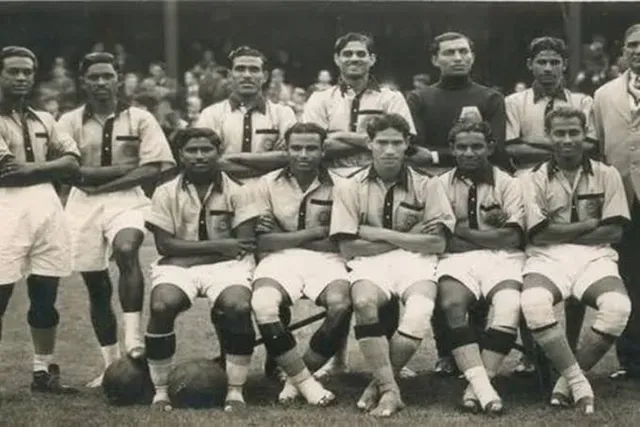
India's first major international football triumph came on home soil at the inaugural Asian Games in New Delhi. It became symbolic for the Blue Tigers to be called the first winners of the Asiad, which eventually became a historical competition. Expectations were high for the team, and they did not disappoint. India, led by the mastermind who sparked India’s golden era in football, Syed Abdul Rahim, convincingly defeated Indonesia and Afghanistan 3-0 to secure their place in the final with stunning attacking football that captivated everyone. Iran was the final opponent standing in their way of glory, with a roaring crowd packing the national stadium. With the country’s leaders in attendance, India understood the gravity of the occasion as winning the Gold in just the fourth year of the nation’s independence would mark a significant moment not only in football but also in their sporting history. It also came a year after India did not travel for the 1950 World Cup hosted in Brazil, having prioritised elsewhere, which became a historical blunder so there was pressure to deliver. Unlike the opposition they faced to make the journey here, Iran was a different challenge altogether as they managed to hold off the sprawling attack of India in the first half and their physicality was hard to contain.
It was up to the Blue Tigers defence, captained by the legendary Sailen Manna, to hold strong, with custodian BK Anthony putting in a superb performance in between the sticks. The team seemed to be under huge pressure and to spark some motivation, the then Prime Minister Jawaharlal Nehru was said to have visited the dressing room at half-time. He lifted the spirit of the players, especially Sahu Mewalal, whom he insisted commit to the team despite the latter receiving a telegram of a personal loss a day before the final and his desire to return to Kolkata. Whatever happened in the reported meeting with the PM at the break worked as India came out a different outfit in the second period. The deadlock was finally broken on the 49th-minute mark, when Runu Guha’s teasing cross was volleyed in spectacularly by none other than Mewalal, having tormented defences all tournament. It was his third strike of the campaign and the decisive one which helped India secure the historic Gold Medal. Mewalal also received a special journey back home as promised to his bereaved family right after the medal ceremony. The victory established them as the rising force in Asia from that competition in front of the home fans and created the foundation for the remarkable decade that followed.
Australia 2-4 India - 1956 Melbourne Olympics
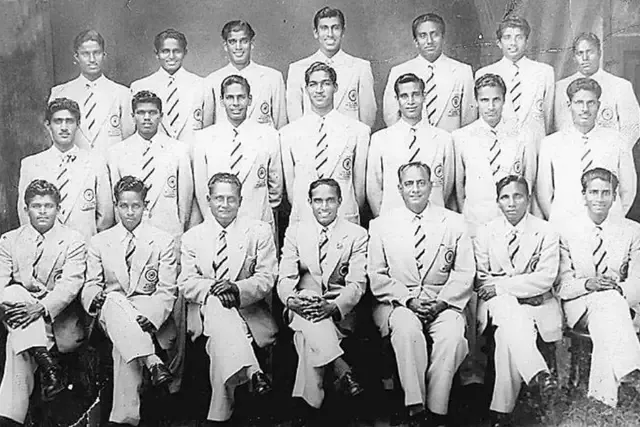
After the Asian Games, the next big moment for India came on the Olympic stage five years later. To this day, it remains one of the most influential results of the national team, stirring the world's attention. The monumental achievement for the Blue Tigers, which we will talk about, came in the 1956 Olympic game hosted in Melbourne, Australia, against the Socceroos themselves at the iconic Melbourne Cricket Ground. Before the tournament, India faced the conundrum of wearing boots after it was made compulsory for all recognised tournaments two years earlier, which might be one of the factors behind the federation’s initial reluctance to send the team to the tournament, as there was disagreement over whether the rules from the FIFA World Cup could be applied to the Olympic competition. However, the Football Association secretary at the time, Sir Stanley Rous, allowed players freedom to decide it, with the Indian team eventually playing with boots along with the condition that they would be allowed to remove them should a player suffer from cramps.
With all things sorted, India faced Australia in a rousing reception from 12000 spectators witnessing history unfold. SA Rahim was in charge of the side again, with revered names like Petar Thangaraj and PK Banerjee part of the group. However, there was one name that would go on to produce an iconic individual performance in Olympic history. There was extreme pressure on Rahim’s men as they failed at the first stage in the 1952 Olympics and Neville D'Souza helped his side erase those disappointments by becoming the star of the show. India led early inside nine minutes with D'Souza burying the rebound of Samar Banerjee’s effort that struck the post. Australia did not lie bare as they equalised from a George Arthur free kick just outside the box that beat the towering Thangaraj, but an error by their own keeper of failing to grab PK Banerjee’s cross allowed D'Souza to grab his second. However, the Indian defence wilted again as the home side levelled it up for the second time to make it 2-2 at the break.
The first-half was chaotically entertaining with goals pouring in for fun, but India needed stability and they achieved it with a gallant pep talk by Rahim Saab at half-time and a tweak in strategy. D'Souza stole the spotlight again with a hat-trick in the 55th minute, making him the first Asian, let alone an Indian, to score three goals in an Olympic football match. The headline undoubtedly belonged to the footballer from Goa, but even his strikes became pale in comparison to the best goal that was scored on that day. The final dagger to Australia's chest was inserted by Krishna Kittu, who made a jaw-dropping 40-yard dash, dribbling past defenders to finish exquisitely to end the quarterfinal tie 4-2, becoming the first Asian nation to reach the last four of the Olympic football tournament. India eventually finished fourth after losing to Bulgaria in the semi-final and then going down to Yugoslavia in the third-place match. Nevertheless, the victory over Australia remains one of the defining moments of the country's golden era, their best finish at the Olympic stage.
India 2-1 South Korea - 1962 Asian Games Final
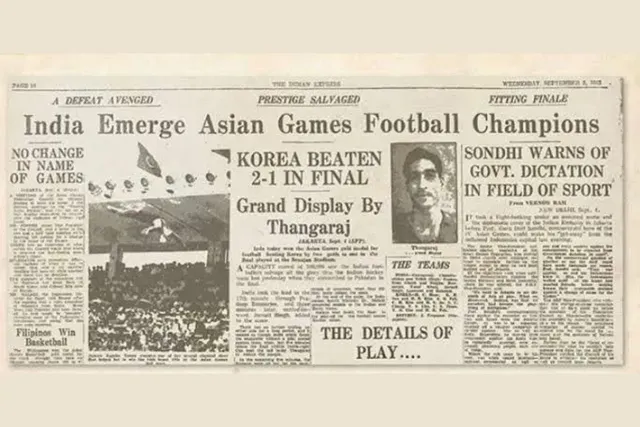
If there is one match that can be considered the defining victory in Indian football history, it is the 1962 Asian Games final against South Korea in Jakarta. It was remarkable not just for what happened on the pitch, but also for the circumstances surrounding the final. The Games had become deeply politicised after Indonesia, under President Sukarno, excluded Israel and Taiwan. The matter turned ugly when Indian sports administrator and Asian Games Federation vice-president, also a former member of the IOC, Guru Dutt Sondhi, strongly criticised the decision and even proposed dropping the term "Fourth" from the Games' official title. His stand triggered an angry reaction in Indonesia, with a mob attacking the Indian Embassy in Jakarta on September 3, a day before the football final. Security was heightened around the Indian football team and even the country’s name was removed from the team bus due to safety. However, even that could not resist the hostility the side suffered on their way to the stadium to play the final, with reports of protesters attacking or pelting the team bus. Security was tightened, and the players were instructed to take precautions, with defender Jarnail Singh even reportedly asked to sit on the floor of the bus so that his turban would not make him easily identifiable as an Indian.
The team had not faced such adversity before the final of the competition as they dazzled through to the showpiece with exceptional football. Now captained by the gem Chuni Goswami, the Blue Tigers showed brilliance in coming second in a group containing South Korea, Japan and Thailand while edging out South Vietnam in a five-goal thriller. However, they lost to the former in the group stage to start the tournament and faced them again in the final. It was a challenging occasion coupled with a hostile atmosphere in Jakarta with over 100,000 local fans voicing their displeasure at them and an unnerving incident leading up to it. Strikingly, India didn't buckle under in what was otherwise a recipe for disaster and produced a sensational performance against a strong Korean side. The national team took the whole occasion as an inspiration and bamboozled the opposition with their stylish football. P.K. Banerjee put India ahead in the 17th minute before Jarnail Singh doubled the advantage three minutes later, despite playing with four stitches in his forehead. South Korea pulled one back late in the match, but Peter Thangaraj and the Indian defence held firm to secure a historic 2-1 victory.
Defender Arun Ghosh, who was famously compared to England’s 1966 World Cup-winning captain Bobby Moore in the 1960 Olympics, recalled the silence that fell over the stadium when India went 2-0 ahead. He also said that the hostility was so intense that hardly anyone came forward to congratulate the Indian players after the final. Remarkably, the Indian team did have some unexpected support in the stands: the Pakistan hockey team reportedly cheered for India. That context makes the 2-1 victory on September 4, 1962 considerably more remarkable. India had not only overcome one of Asia's strongest football teams but also an extraordinary political and emotional atmosphere surrounding the final. It remains India's greatest football triumph and their first major international title won overseas. This victory over South Korea to win the Gold remains the benchmark for the side and one of the most important ones gathered under the watch of Rahim Saab in the golden era.
India 2-0 South Korea - 1964 AFC Asian Cup
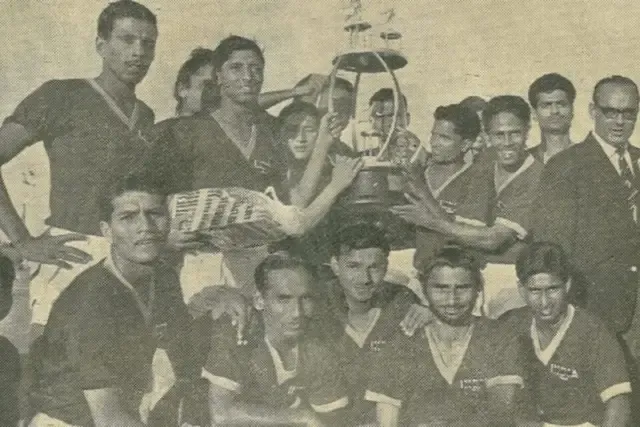
Four years later, these two crossed paths again but in a different competition with a different format. India were competing in their first-ever AFC Asian Cup in 1964, hosted in Israel and were determined to continue their momentum of success in the recent Asian Games and top showings in the Olympics. There was expectation on them to do well again with familiar foes South Korea to face in the tournament opener. The Indian team had retained most of the Asian Games squad, so the stars were looking to fire up against the familiar opponents again. However, South Korea entered as the defending champions after winning the first two editions of the competition, while the Blue Tigers were only getting the first taste of it. On top of it, the circumstances surrounding the match were difficult. The side was longer coached by SA Rahim, who died of cancer a year ago, while on the morning of the match on May 27, 1964, the Indian team received the news that Prime Minister Nehru had passed away. The players were said to have lost all motivation upon hearing the news and asked the game to be postponed, but it was not possible due to the tight schedule.
Yet, India once again showed their unparalleled spirit in a difficult period, with the team taking to the pitch of the Kiyret Eliezer Stadium in Haifa donning black armbands and carrying the emotional weight. Despite the circumstances, India produced a sensational performance against the two-time champions. Just like their Asian Games final two years ago, the Blue Tigers, under Englishman Harry Wright in the dugout now, struck early with K. Appalaraju finding the net inside three minutes, disrupting South Korea’s flow altogether. Defender turned goalscorer, Jarnail Singh proved to be a nightmare for the opposition again as he struck on the hour mark to make it 2-0. South Korea hoped to produce a response, but this time their luck ran out. India clinched a notable win, maintaining a clean sheet and showing their calibre in a game they hesitated to play at first. The victory proved to be the perfect start to India's first Asian Cup campaign. Although India subsequently lost 2-0 to hosts Israel, they recovered to defeat Hong Kong 3-1, finishing runners-up with four points, behind champions Israel. It remains India's best-ever finish at the AFC Asian Cup, making the opening victory over the defending champions an especially significant chapter in the national team's history.
India 1-0 Japan - 1970 Asian Games Bronze-Medal Match
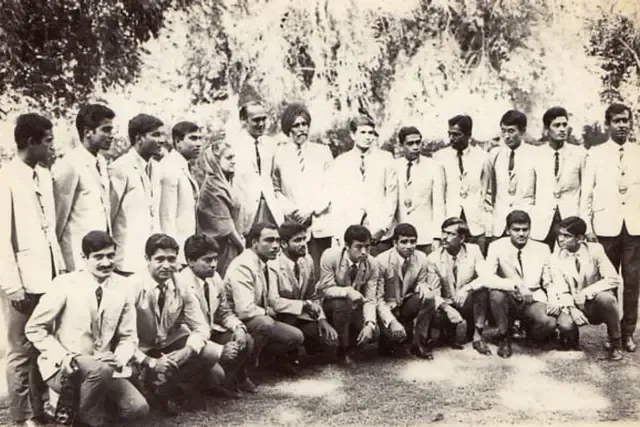
The final game that is worth mentioning among the historical victories of the Indian Football Team is India’s Bronze-Medal triumph at the 1970 Asian Games in Thailand against another Asian powerhouse of the sport, Japan. The match provided a fitting final chapter to the country's golden era. By then, India had already won Asian Games gold in 1951 and 1962 and finished runners-up at the 1964 AFC Asian Cup. The 1970 campaign in Bangkok offered another opportunity to compete for continental honours, although the team entered the tournament without some of its established stars, including injured striker Inder Singh. Still, the squad, led by captain Syed Nayeemuddin and managed by PK Banerjee this time, was determined to give their all. Under their guidance, the Blue Tigers managed to reach the semifinal stage after victories over South Vietnam and Indonesia. However, India's hopes of reaching the final ended with a 2-0 defeat to defending champions Burma, sending them into the bronze-medal match against Japan. The fixture offered India an immediate opportunity for redemption, as Japan had beaten them 1-0 just two days earlier in the second-round group stage, with Takeo Kimura scoring the decisive goal in the 88th minute.
As India had proven before in thriving on such occasions with medals at stake, they did it once again to win the hearts of the fans. This time, however, India produced a legendary disciplined defensive performance. Amar Bahadur scored the only goal in the 36th minute, while right-back Sudhir Karmakar played a crucial role in keeping Japan's dangerous attack and especially Japanese star Kunishige Kamamoto, under control. His performance was so impressive that FIFA president Sir Stanley Rous took the microphone after the game and hailed Karmakar as “Asia’s best defender”. Rous also praised India as the best technical side in Asia, according to members of the Indian team. The 1-0 victory secured India their third Asian Games football medal, following gold medals in 1951 and 1962. More importantly, it remains the last Asian Games football medal won by the Indian men's national team. The achievement therefore represents more than just another historic victory: it marked the final podium finish of India's celebrated golden generation and brought an important chapter of Indian football history to a close.