
Elite athletes live a borderless life by default. A tennis player on the ATP Tour competes across four continents in a single season, while a footballer transferred mid-career might hold residence in one country, a salary taxed in another, and a passport that restricts both.
That friction has made a second passport less of a luxury and more of a practical tool. Citizenship by investment, golden visas, and ancestry claims each offer athletes a route to dual nationality, but the right one depends on timing, income structure, and the competition calendar they cannot move.
This guide breaks down what actually works for a competing athlete in 2026, from processing realities to the tax and eligibility questions that follow a new passport home.
Key Takeaways
Athletes have at least three legitimate routes to a second passport: citizenship by investment, golden visas, and ancestry claims.
In-season timing and biometric requirements shape which route is realistic for a competing athlete.
A second passport can affect tax residency, sponsorship contracts, and eligibility for national team competition.
Female athletes face distinct accessibility gaps across current 2026 investment migration programs.
Working with an experienced advisor reduces the risk of costly application mistakes or rejections.
Why Athletes Are Rethinking Mobility and Citizenship
A mid-season call-up, a sponsorship clause, or a visa delay at an airport can cost an athlete a tournament. Passport strength determines how much of a career runs on borrowed time.
Visa restrictions tied to a single nationality limit which training camps, exhibitions, and commercial appearances an athlete can accept without weeks of advance planning.
Cross-border athletes increasingly treat a second passport as career infrastructure, alongside a trainer or an agent, rather than a one-time financial decision made late in life.
Comparing the Three Main Routes: Cost, Timeline, and In-Season Feasibility
Each path trades cost against time, and time is the variable an active athlete cannot spend freely. Investment migration options vary widely across these three categories.
Citizenship by Investment Programs
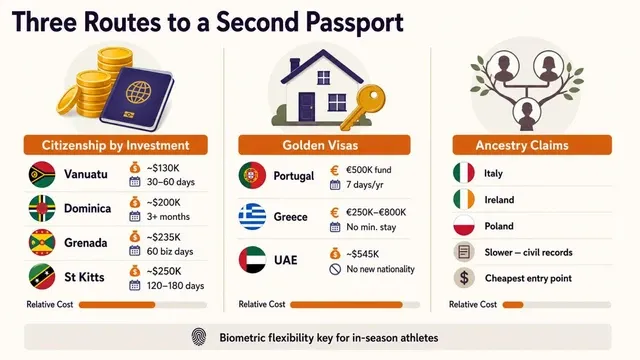
Caribbean citizenship routes remain the fastest. Vanuatu is reported near US$130,000, processed in 30 to 60 days, with biometric enrolment available in Dubai, Hong Kong, or Nouméa rather than in-country. Dominica sits near US$200,000 with at least three months to approval.Grenada targets roughly 60 business days at around US$235,000 for a family of four, while Saint Kitts and Nevis runs US$250,000 with 120 to 180 days and mandatory biometrics from April 2026.
Golden Visas and Residency by Investment
The Portugal Golden Visa now requires a €500,000 fund subscription or similar qualifying investment, with physical presence near seven days a year, ideal for an athlete who cannot relocate. The Greece Golden Visa uses real estate from €250,000 to €800,000 in prime cities, with no minimum stay requirement. The UAE Golden Visa offers renewable residence from roughly US$545,000 but grants no new nationality.
Ancestry Citizenship Claims
Italy, Ireland, and Poland allow ancestry citizenship through documented lineage, cheaper but often slower once civil records, translations, and legalisation enter the picture. For most competing athletes, a golden visa fits the season better than an unresolved ancestry file.
Athletes weighing these options benefit from guidance tailored to a competition schedule. Global Residence Index for investors abroad works directly with government bodies across these jurisdictions, structuring applications around training and tournament calendars rather than generic residency timelines.
How a Second Passport Affects Tax Residency and Cross-Border Earnings
A second passport does not automatically shift tax residence. Domestic day-count rules, permanent-home tests, and where an athlete manages personal and economic relations still govern tax status.
Double-Taxation Treaties and Prize Money
Prize money earned across jurisdictions can be taxed twice without a treaty in place. Dual nationality adds flexibility but does not remove the need to track where tournaments, endorsements, and residence overlap.
Salary Across Multiple Jurisdictions
A footballer in the Premier League or La Liga quota system still owes tax based on residence and source rules, not passport alone. The 90-day rule in several European states can quietly trigger unwanted tax residency during an extended off-season stay.
Professional tax advice alongside immigration planning remains essential before any investment migration decision is finalized.
Second Passport vs. Athlete Visas: P-1, UK Sportsperson, and Beyond
Many athletes never need a second passport at all. A P-1 visa covers internationally recognized athletes competing in the United States, while the UK Sportsperson route serves a similar purpose for the Premier League and other domestic competitions.
These athlete visas solve a narrower problem. They grant entry and work authorization tied to one event, one club, or one season, without the permanence of citizenship by investment or a golden visa.
When a Visa Makes More Sense Than Citizenship
A short-term contract, a single tournament circuit, or a one-season loan rarely justifies the cost of residency by investment. Visa sponsorship through a club or federation is faster and cheaper for a defined window.
Citizenship becomes the stronger choice once an athlete faces repeated visa restrictions, holds a weaker passport with limited visa-free travel, or plans a multi-year career spanning several competition circuits.
Sponsorship and Endorsement Considerations
Endorsement contracts sometimes require an athlete to appear at short notice across multiple countries. A visa tied to one employer rarely allows that flexibility; dual nationality or a second passport often does.
Sponsors increasingly ask about an athlete's travel freedom before signing multi-market deals, since visa delays can jeopardize campaign timing in ways a stronger passport avoids entirely.
The Application Process From an Athlete's Perspective
The mechanics of citizenship by investment or a golden visa do not change because the applicant plays professional sport. The paperwork, however, tends to look slightly different.
Documentation and Federation Letters
Standard due diligence requires police certificates, proof of funds, and certified identity documents. Athletes often add federation letters, contract copies, or governing-body confirmations to explain irregular income and frequent travel history.
Source-of-funds checks can take longer when prize money, endorsement income, and signing bonuses arrive from several countries in a single year. Clear documentation trails shorten this stage considerably.
Biometrics and Timing Around the Competition Calendar
Biometric enrolment is the step that most often collides with a competition calendar. Programs such as Vanuatu and some Caribbean citizenship routes allow biometric appointments at overseas centres in Dubai, Hong Kong, or Nouméa, sparing an athlete an in-country trip during the season.
Saint Kitts and Nevis made biometric enrolment mandatory for applications filed from 14 April 2026, a shift athletes and their advisors should factor into scheduling well before submission.
Working with an advisor who understands both the Portugal Golden Visa and Caribbean citizenship by investment allows appointments to be mapped against training blocks rather than left to government default scheduling. Global Residence Index structures these timelines around an athlete's actual season.
Female Athletes and the Accessibility Gap in 2026 Programs
Investment migration has traditionally been priced and marketed toward individual high earners, a category that still skews toward men's professional sport in total prize money and sponsorship value.
What the Data Shows
Lower average career earnings in many women's sports can make a US$200,000 Caribbean citizenship contribution or a €500,000 golden visa fund subscription harder to justify without sponsorship support or team backing.
Family residence rights attached to several programs partly offset this, since a spouse or dependent can often be included without a separate full application fee.
Programs Closing the Gap
Some federations and leagues have begun subsidizing relocation and mobility costs for contracted female athletes, treating a second passport as retention infrastructure rather than a personal luxury.
Programs with lower entry points, such as Vanuatu's citizenship by investment route, remain more accessible to athletes without major endorsement income, though professional advice remains essential before committing funds.
Eligibility Under FIFA, IOC, and National Federation Rules
A second passport does not automatically open the door to new national team eligibility. Sporting bodies apply their own nationality rules on top of whatever a government grants.
Olympic Charter Nationality Provisions
The Olympic Charter generally requires an athlete to hold the nationality of the country they represent, but switching federations after naturalization often triggers a waiting period set by the relevant international federation, not the National Olympic Committee alone.
FIFA Nationality Rules and the World Cup
FIFA nationality rules allow a player to switch association only under specific conditions, including never having played a senior competitive match for the former country. A World Cup cycle can make timing a second passport critical, since eligibility windows close well before the tournament itself.
Dual nationality from ancestry citizenship or a residency by investment route can satisfy a federation's nationality requirement, but each case still needs confirmation from the sport's governing body before any investment decision is made.
Succession Planning and Life After Retirement
Retirement planning for athletes increasingly includes citizenship, not just portfolios. A second passport secured during an active career often becomes the foundation for where a family settles permanently.
Estate Planning for High-Net-Worth Athletes
High-net-worth athletes use dual nationality to diversify estate exposure, since different jurisdictions tax inheritance, trusts, and property very differently once competitive income ends.
Relocation Benefits Post-Career
Post-career mobility matters too. A Portugal Golden Visa or Greece Golden Visa can convert into long-term residence, supporting education, healthcare, and lifestyle decisions after retirement.
Global Residence Index advises athletes early, while Vancis Capital supports the broader investment migration structure behind each citizenship by investment or residency by investment decision.