The Japanese Grand Prix, held at the iconic Suzuka International Circuit, is one of the prominent venues on the Formula 1 calendar. It has been staged over 40 times, but not every race was part of the F1 World Championship. The first two races were held at Fuji Speedway, and later, it opted out of hosting an F1 race. Until Formula 1 returned to Suzuka in 1987.
However, F1 returned to Fuji Speedway in 2007 and then returned to Suzuka in 2008. The Japanese Grand Prix has regularly produced unforgettable moments, from pivotal championship finals to challenging on-track battles. In this article, we will look at the history, stats, and records made at the Suzuka International Circuit.
History Of The Suzuka International Circuit
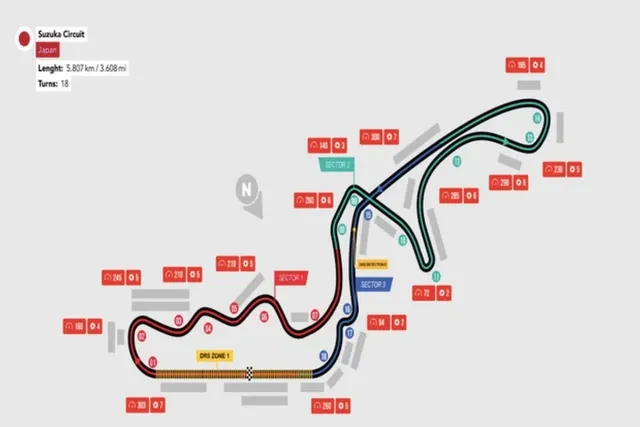
The Suzuka International Circuit is a motorsport racing track. It was built in 1962 in Suzuka City, Mie Prefecture, Japan, by Soichiro Honda. The reason for constructing this track was to use it as the test track for Honda’s new upcoming vehicle development program. Designed by Dutch architect John Hugenholtz, the track is 5.807 km in length and has an average capacity of 155,000 people. Nowadays, the track has been incorporated by Honda Mobilityland.
The first Japanese Grand Prix was held in 1987 and was won by driver Gerhard Berger, driving for the Scuderia Ferrari F1 team. This was the year that Suzuka hosted both F1 and the World Motorcycle Championship consecutively. The most significant change was the Degner curve was made into two corners to produce more run-off areas. It is the only circuit that is shaped as the digit 8.
First Race | 1987 |
Last Race | 2024 |
Track Length | 5.807 KM |
Total Turns | 18 |
Total Laps | 53 |
Most Pole Positions | Michael Schumacher (8) |
Most Japanese GP Win | Michael Schumacher (6) |
The circuit is 5.807 km long and has 53 laps for the upcoming 2025 Japanese Grand Prix. It has 18 turns with only 1 DRS detection zone. One of the most prominent features of the track is a high-speed chicane that resembles an S-shaped curve, 130R, which pivoted the ultimate driving challenge to drivers.
Suzuka International Circuit: Key Features
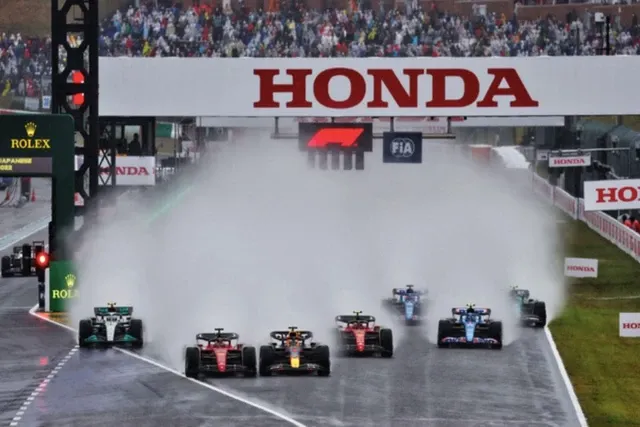
Suzuka International Circuit has been decoded with title-deciding races. The reports state that a record 13 titles have been won here, including five straight from 1987 to 1991. It is one of the most difficult tracks in the Formula One calendar due to its extremely complex layout. The legendary 130R, a high-speed corner, tested aerodynamics and driver skills to their limits. The track's complex design results in high tire degradation during the race.
Japanese Grand Prix: Notable Records and Milestones

The Japanese Grand Prix has acquainted itself with a couple of records in the history of Formula 1. Here are some honorable mentions.
Japanese GP Fastest Lap: The fastest lap record at the Japanese Grand Prix was held by Lewis Hamilton in 2019. Lewis Hamilton achieved this at 1:30.983 seconds while driving for Mercedes F1.
Most Japanese GP Wins: Michael Schumacher has the most successful Japanese GP wins, winning it 6 times in 1995, 1997, 2000, 2001, 2002, and 2004.
Most Pole Positions: This record is also held by Michael Schumacher. He achieved pole positions 8 times, in 1994, 1995, 1998, 1999, 2000, 2001, 2002, and 2004.
Most Constructors Win: The only team in the current 2025 season with the most constructor victories at the Japanese Grand Prix is the McLaren F1 Team. They won in 1988, 1989, 1990, 1991, 1998, 1999, 2005, and 2011.
Read More: Why did the Japanese Grand Prix reign Supreme In Asia To Host Formula 1?