
The year 2025 was probably the darkest period in Indian Football history, with a series of controversies grappling with the sport in the country. The Indian men’s football team's struggles continued as they slumped further down the FIFA rankings, enduring embarrassing defeats amid some slender hopes under the new management. The case of the I-League winner decider went to the Court of Arbitration for Sport (CAS) to resolve, with Inter Kashi declared champions after AIFF was forced to backtrack on their decision of awarding the title to Churchill Brothers. However, the real crisis that plagued football in India was the uncertainty of the Indian Super League. The owners of FSDL paused the league following their disagreement on MRA renewal with the federation and with the existing deal expiring in December 2025, the league's future was plunged into darkness.
However, the New Year 2026 is bringing light to the end of the dark tunnel, with Indian football expected to have a much more positive period after a chaotic one. Foremost, the issue of ISL finally coming to an end, with all clubs finally set to participate after a series of meetings and disagreements with the AIFF following intervention by the sports ministry. Despite being a year to forget, 2025 was fairly joyous for women’s football as the national team qualified for the Women’s Asian Cup in three age categories. All of the tournaments will be held this year, making 2026 a significant and probably symbolic year for the women’s game in the nation. Overall, the New Year is full of promises and expectations that Indian football is in desperation to meet or exceed for a prosperous period in its history.
We list down all things to look forward to in Indian football in 2026:
India at the 2026 AFC Women’s Asian Cup
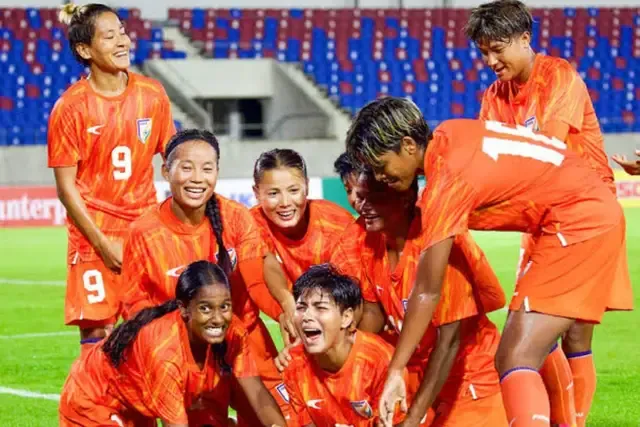
Amid a period of uncertainty and disappointment in the men’s football team in 2025, the women’s team gave all the smiles as they secured a historic feat of booking their spot in three Women’s Asian Cups in different age categories in a single year. For the first time, the Senior Women’s Team will be playing at the Asian stage on merit after hosting the previous edition in 2022, which ended in an early elimination due to a Covid outbreak in the squad. Replacing the heartbreak of the competition and the huge slump in performance that followed, the women’s team scripted a wonderful tale in qualifying for the 2026 edition in emphatic style. The Blue Tigresses topped their qualifying group of 2026 AFC Women’s Asian Cup, winning a do-or-die affair against Thailand in the final game with Sangita Basfore scoring the winner to complete her brace and send them through.
India will face tough opponents in the main competition, hosted in Australia in March 2026, after being grouped with two-time winners Japan, Vietnam and Chinese Taipei. The match against the latter in the previous edition was the one that got cancelled due to India's inability to name the required players for the match, leading to their elimination. They will be the last opposition to take on in Group B on 10 March 2026. That game is set to be the decider for the third spot, as Vietnam, who India face in the tournament opener, and Japan are expected to take the top two spots in the group. A lot of emotions will be riding on that game and the entire tournament, as the top two teams from each group, along with the two best third-placed teams, will qualify for the quarter-finals. The winners will qualify for the 2027 FIFA Women's World Cup, so there will be a chance to create more history for the Blue Tigresses at the 2026 Women’s Asian Cup.
U20 and U17 girls set for history
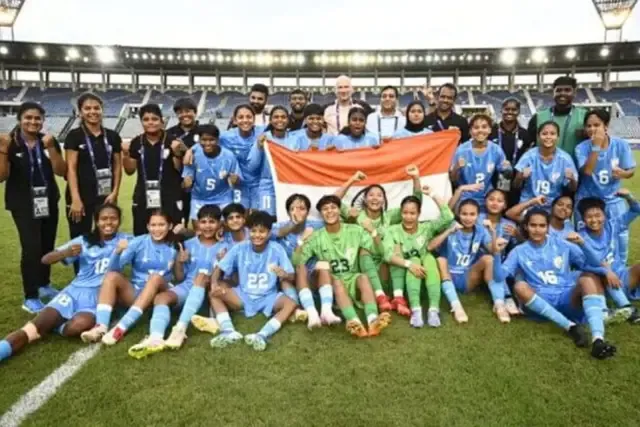
Besides the senior team, India qualified for the Women’s Asian Cup in two more age categories - U20 and U17 in the previous year. Among them, the junior-most side will be experiencing the tournament for the second time, after their debut in 2005, although this is the first time India’s U17 side will compete. The young Tigresses dominated their qualifying group, which included Kyrgyzstan and Uzbekistan, beating both teams 2-1 and securing a berth in the group stage of the U17 Asian Cup, hosted in the neighbouring country of China. It was also a redemption arc for the U17 side, who failed miserably at the FIFA U17 Women’s World Cup hosted on their soil in 2022. India will now carry the dream of qualifying for the tournament, hosted in Morocco in October, on merit this time, if they finish among the top four teams in the Asian Cup starting from April 2026.
Similarly, making a return to the Asian stage after a 20-year-hiatus is the U-20 women’s team experiencing a stunning qualifying campaign as well. Despite playing a goalless draw against Indonesia to start with, the team quickly forgot about the result as they demolished Turkmenistan 7-0 and edged out Myanmar 1-0 in the final game to clinch the top spot and secure qualification to the finals for the fourth time. Managed by Joakim Alexandersson, also the coach for the U17 side, India’s U-20 Women’s team will now hope to make their hard work pay off, arriving at the U-20 Women’s Asian Cup unbeaten and without conceding a single goal. Similar to the other age levels, the side will have the chance to qualify for the 2026 FIFA U-20 Women's World Cup in Poland if they finish among the top four in the U-20 Women’s Asian Cup, but unlike the rest, they have a history in this competition, having ended as quarterfinalists in 2004, their highest showing so far, giving them confidence. Check here for India in AFC U20 Women’s Asian Cup: Opponents and Fixtures
U17 boys team in the 2026 U17 Men’s Asian Cup
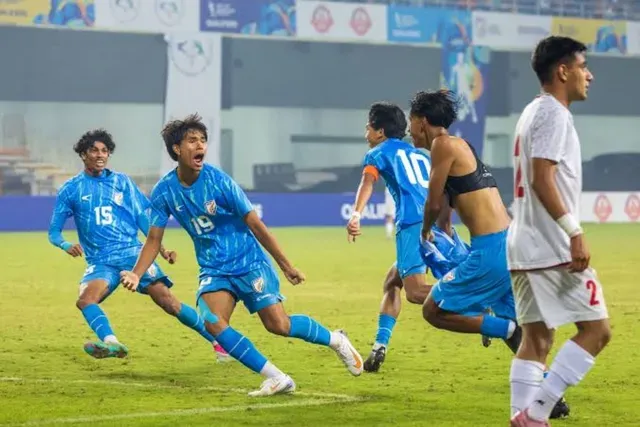
In a gloomy and dark 2025 for men’s football in the country, the U17 boys gave a rare high point by qualifying for the 2026 U17 Men’s Asian Cup hosted in Saudi Arabia in May 2026. This is their 10th appearance at the Asian stage, and once again, the architect behind their success was the head coach Bibiano Fernandes. This will be the fourth consecutive time the Goan tactician has led the Blue Colts into the U17 Asian Cup, enduring one of the hardest qualifying campaigns this time. Grouped with top dogs like Iran, Lebanon, Palestine and Chinese Taipei, with only the group winners advancing to the main tournament, there was doubt if India would pull it off. At the end, the team proved their mettle again by topping their qualifying group with the historic 2-1 win against Iran in Ahmedabad in the winners-takes-all tie, becoming the pick of the bunch.
After a somewhat disappointing start with a 1-1 draw against Palestine, despite taking the lead, the team turned back the results with sublime wins over Taipei and Lebanon. However, India fell behind in the crucial game of them all, with Iran taking the lead inside just 19 minutes. With qualification hopes dangling, the Blue Colts made a strong comeback after levelling the score on the stroke of half-time as the side’s Dallalmuon Gangte by dispatching from the spot to pave the way for Gunleiba Wangkheirakpam to find the winner just seven minutes into the second half. Both teams ended on equal points, but India edged out on head-to-head to secure their place in the U17 Asian Cup yet again. Twice quarterfinalist at the stage, the Indian team failed to come out of the group stage in the last edition, collecting just one point. The side will be desperate to change in the upcoming edition, which is going to be an important international tournament to watch alongside the women’s in 2026.
Men’s team battles dark period
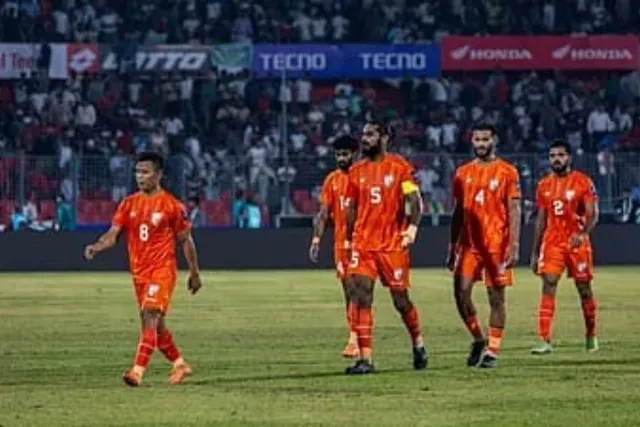
Crisis deepened for the senior men’s team in 2025 after a horrid 2024 that saw them fail to secure a single victory. While the Blue Tigers managed to end a 12-game winless run with a crucial 3-0 win against the Maldives ahead of the Asian Cup third round qualification campaign in an international friendly in the first game of last year, it became a false alarm at the end. The team frustratingly drew goalless with Bangladesh in Shillong to start with and conceded a last-minute goal against Hong Kong, losing 1-0 in the second game and jeopardising their chance of qualifying for the Asian Cup early. That set of results, including a 2-0 defeat to Thailand, forced Manolo Marquez to step down from his managerial role. India was left in a limbo, but found some hope when one of the best current Indian coaches, Khalid Jamil, took charge of the national team, wishing to change the fortunes of the side.
Having a first Indian coach in the dugout since 2012 initially brought a good impact, as the appointment of foreign coaches yielded nothing over the years. The team seemed to click on to his idea and had a memorable CAFA Nations Cup, where they finished third, losing only to eventual finalists Iran despite locking them 0-0 at half-time. However, all hopes of a revival came crashing down when they resumed the Asian Cup qualifying campaign. India required a defensive error from Singapore to salvage a late equaliser to save them from defeat in the 1-1 draw away, before losing the reverse game at home, where they lost a 14-minute lead, ending their chances for a third consecutive appearance at the Asian Cup. If that was not enough, the Blue Tigers sank into further embarrassment when they lost to lower-ranked Bangladesh for the first time in 25 years to close 2025.
Hence, there is not much optimism around the senior men’s national team in 2026 who has slipped to 142 in FIFA rankings and risks going down even further if things don’t change quickly. The first step for India will be to make sure they don’t end their qualifying campaign winless, which probably would be their worst in history, as they take on Hong Kong in the first game of 2026 in March. However, that fixture will be a difficult one as they and Singapore are locked in a race for the top spot to qualify for the Asian Cup. Even though India will have nothing on their shoulders in that fixture, Hong Kong has everything to play for and will take the game seriously. Regardless of the outcome, every stakeholder involved in Indian football has to give the men’s team priority over everything else and it is left to see whether the dismal record finally gives the required shake-up to begin a revival for the side in 2026.
Indian Super League Finally Returns in 2026
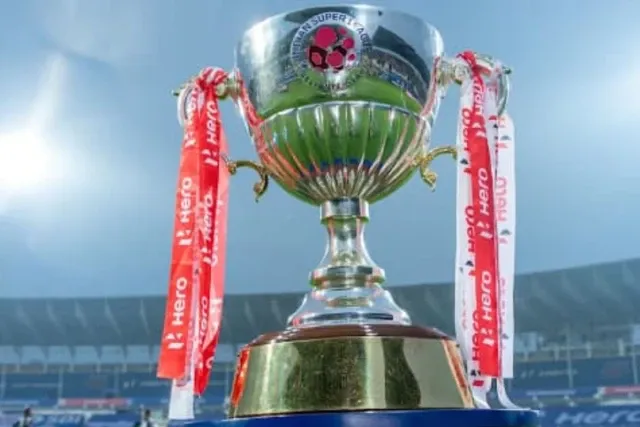
No other crisis was bigger for Indian football in 2025 than the country’s top division for men’s football, the Indian Super League’s future getting thrown into darkness. The league was halted in July 2025 following disagreement between FSDL and AIFF over MRA renewal, which was not resolved for long, prompting the federation to float a new tender. However, nobody came forward to be the commercial partner of the top flight, to the shock of the federation and little surprise of the fans, with the 11-year contract running down in December 2025 deepened the uncertainty. The approval of the new AIFF constitution by the Supreme Court after a long delay brought the debate over ownership of the league, which created further disagreement between clubs and the federation over a short-term and a long-term plan to revive the league. Almost half a year without any league caused huge ramifications with both clubs and AIFF enduring losses, while foreign players, even those who became the face of the ISL, cut ties to seek pastures new for game time. Domestic players were left with uncertainty and appealed to FIFA to intervene.
With things turning sour and reputational damage along with financial strain occurring, the sports ministry had to intervene, forcing all parties to finally agree to a truncated league this season, which means there will be football in 2026. The start date of the league has been scheduled for 14 February 2026, but it will be less than Valentine's Day, as several clubs will require players to have pay cuts to sustain themselves, with many fielding an all-Indian squad. Some, like Odisha FC, might not participate at all due to the losses the club has incurred. Yet the positive side is that the ball is finally going to roll and AIFF is confident there will be takers of being a commercial partner for the league this time when the tender will be floated again. The federation has also drafted a long-term 20-year stable plan starting from next season. All of these developments are positive and could restructure the top flight in the coming years, but it remains to be seen whether AIFF manages to make it sustainable now that they hold ownership of ISL even though clubs will have major shares according to the new revenue model. Nevertheless, the ISL uncertainty is set to end in 2026, which gives a whole lot of comfort this year.