Few World Cup rivalries carry as much emotional weight and historical significance as England vs Argentina. Their meetings have been separated by decades, but every encounter has left behind unforgettable memories. From England’s dominance in the 1960s, Maradona’s excellence in 1986, to the Three Lions' redemption at the turn of the century, every moment has created history like no other. It is not merely a contest between two football teams but a clash of cultures, generations and memories. Unlike many rivalries built purely on footballing competition, England vs Argentina has always carried additional layers. The political shadow of the Falklands War, contrasting football cultures and the presence of some of the greatest players in history have made every World Cup meeting between these two nations a global spectacle. The two sides have met five times in FIFA World Cup history, with Argentina winning three, England winning two, and the rivalry producing 13 goals across five matches. From Wembley to Sapporo, this clash remains one of the most fascinating rivalries in FIFA World Cup history as a new chapter between the two is set to unfold in North America.
Here is a detailed look back at every World Cup meeting between England and Argentina:
England 3-1 Argentina (1962 World Cup Group Stage) - The Three Lions get the first
The first World Cup meeting between England and Argentina came during the 1962 FIFA World Cup in Chile. At the time, England were still searching for their first major international success, while Argentina were already a respected football nation with appearances in previous World Cup tournaments. Both teams were drawn in the same group, alongside Hungary and Bulgaria. Their meeting at the Estadio El Teniente was crucial, with both sides needing a positive result to strengthen their qualification hopes. England started the match aggressively and took control early. Ron Flowers opened the scoring from the penalty spot in the 17th minute after Argentina conceded a foul inside the box. England doubled their advantage through Bobby Charlton, who was beginning to establish himself as one of the finest players in world football. A third goal for the Three Lions was added by Jimmy Greaves, before José Sanfilippo scored a consolation late in the game, to secure a convincing 3-1 win. The victory helped England progress from the group stage, while Argentina were eliminated after finishing third. This was England’s first World Cup victory over Argentina and set the tone for their early dominance in the fixture.
England 1-0 Argentina (1966 World Cup Quarterfinals) - Host claim a massive result
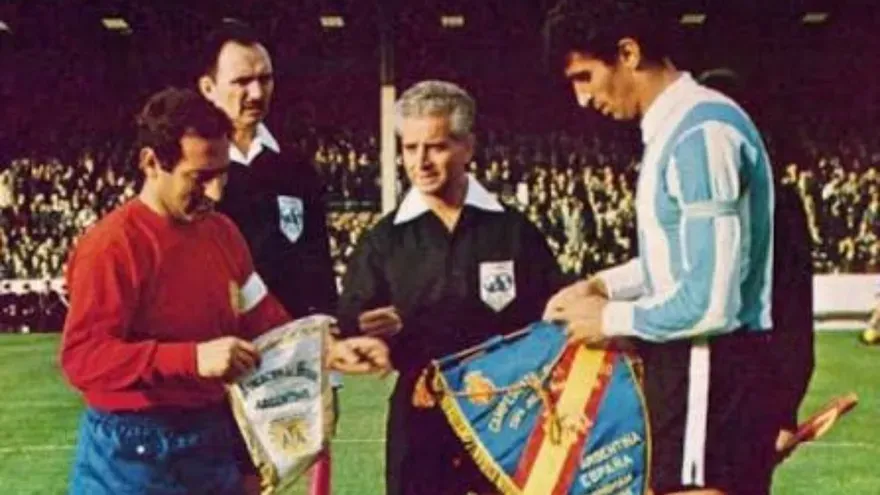
The 1966 World Cup was special for England because not only was it hosted on their home soil, but they went on to lift their only trophy, then known as the Jules Rimet trophy, to date in front of their own fans at Wembley Stadium with a historic 4-2 win against Germany in the final. In the run, the Three Lions also overcame Argentina’s challenge in the quarterfinals. The rivalry between the two reached the knockout stage for the first time. Alf Ramsey’s legendary team up against a solid La Albecieste was the making of a great recipe. The last-eight tie was played at Wembley as well, the place they will eventually touch the holy grail, but it also became one of the most controversial matches of the tournament. The game was fiercely contested, with both teams struggling to create clear chances. The first major talking point came in the 35th minute when Argentina captain Antonio Rattín was controversially sent off after an altercation with referee Rudolf Kreitlein. The South American giants disputed the decision, with Rattín famously refusing to leave the pitch initially due to language difficulties and later over the referee’s ruling. Despite playing against ten men for much of the match, England struggled to break through Argentina’s defence. The breakthrough finally came with just 10 minutes remaining in normal time when Geoff Hurst headed home from Martin Peters’ cross. The victory propelled the Three Lions to the ultimate glory, while the opposition was left hard done by the refereeing decision, igniting the rivalry.
Argentina 2-1 England (1986 World Cup Quarterfinals) - Maradona creates history
The most famous game, whenever this fixture has come into conversation and the World Cup in general, certainly came in the quarterfinal clash of the 1986 edition hosted in Mexico. This meeting, played in the legendary venue Estadio Azteca in Mexico, also had a major controversy, but the one that favoured Argentina this time, while it also produced an iconic performance from a footballing great, Diego Armando Maradona. The game was also politically charged as it came just four years after the Falklands War between Argentina and the United Kingdom, adding enormous emotional significance to the encounter. Before the game, both sets of fans clashed, leading to several English supporters getting hospitalised. Both teams entered the contest with contrasting form, with the Three Lions gradually improving on their way to the last eight while the footballing world was buoyed by the skills of Maradona, making his nation title contenders.
After a goalless first half, the most talked-about moment whenever this clash is mentioned happened just six minutes after the restart. Maradona, who has already provided the England defence with a lot of issues, latched onto a miscued clearance from his own pass and seemed to have got ahead of the towering Peter Shilton, who came out of his area to punch the ball, despite his short height, to find the net. However, the replay showed that Maradona had clearly used his arm and not his head to score one of the contesious goal in World Cup history. The England players were infuriated, but the referee said he did not spot the handball and let it stand. VAR was a distant thought back then, so there was no chance of a review. Maradona later stated that the goal was scored ‘a little with the head of Maradona and a little with the hand of God’, giving the goal its famous name of ’Hand of God’.
But that was not all. Just four minutes later, the same man produced a moment widely regarded as the greatest goal not just in the World Cup but in football history. Maradona received the ball in his own half and then started an incredible 60-yard dash towards the opposition goal, going past four players with his unearthly dribbling and turn of pace, before a feint that took Shilton out of the game and then slotting into the empty net in a stunning 10-second storm from the Argentinian captain to make it 2-0. The goal was voted the ‘Goal of the Century’ in 2002 for the moment that would hardly ever be repeated. Lightning struck twice and with elimination looming, England refused to go down without a fight. Substitute John Barnes changed the game, creating chances and helping Gary Lineker score in the 81st minute. The Three Lions pushed for an equaliser, but Argentina held on. The victory sent Argentina into the semi-finals, where they defeated Belgium before beating West Germany in the final. Maradona’s two goals became symbolic of his entire career, genius and controversy existing together.
Argentina 2-2 England; Argentina won 4-3 on penalties (1998 World Cup Round of 16) - Classic World Cup thriller
Another crazy affair in this rivalry happened 12 years later in the fourth World Cup meeting between the sides. It had everything one could imagine, making it a World Cup classic. Both teams entered the match with exciting young talents. England had emerging stars such as David Beckham, Michael Owen and Paul Scholes, while Argentina featured Gabriel Batistuta, Ariel Ortega and Javier Zanetti. The high-octane encounter began with a flurry of early goals. Batistuta opened the scoring for Argentina in only the sixth minute from the spot after now Atletico Madrid manager Diego Simeone, more on him later, was fouled by David Seaman in the England box. He became the record scorer for Argentina in the World Cup finals until that record was broken by a certain Lionel Messi. The Three Lions then won a spot-kick for themselves just four minutes later when Owen went down inside Argentina’s box, but he barely had a touch from the defender. Alan Shearer stepped up to take the penalty, which he finished emphatically. There was doubt on the penalty call, with Owen going down easily, but there was no question about the second goal he scored for England.
The then-teenage prodigy brilliantly took a forward ball from Beckham near the half-line, made a darting run before getting past the Argentinian defence and then smashing past goalkeeper Carlos Roa for a mesmerising goal that ultimately came a little short of Maradona’s ‘Goal of the Century’ in voting. It was a strike of the highest order and it gave England a 2-1 lead. However, right before half-time, La Albecieste came into the game through Zanetti. Then came the heated moment of the game when Beckham was shown a straight red card after retaliating for a foul on him committed by Simeone with a light kick out at the Argentinian, which the latter made the most of it. Despite being reduced to ten men, Glenn Hoddle's England side managed to hold on for a 2-2 draw through extra time, setting up a decisive penalty shootout. There, Argentina’s goalkeeper Carlos Roa became the hero after he saved David Batty’s final penalty to send his nation to the quarterfinal, giving England fans another heartbreak at the end of a thrilling game.
England 1-0 Argentina (2002 World Cup Group Stage)
However, England would get their much-awaited revenge four years later at the 2002 World Cup when they were drawn against Argentina in the group stage of the tournament. This was a match that also possessed an opportunity for Beckham to redeem himself from the infamous red card incident in the previous encounter. As a case, the match became one of the most anticipated group-stage fixtures in tournament history. England entered the game under pressure after drawing their opening match against Sweden, while Argentina were considered one of the favourites after arriving with a golden generation featuring players such as Juan Sebastián Verón and Hernán Crespo now alongside Batistuta. Played at the Sapporo Dome, the encounter was tense and tactical. England earned a penalty shortly before half-time when Owen once again went down from the faintest of touches from the now US men’s national team coach, Mauricio Pochettino. Beckham stepped up to take it and drilled it for the only goal of the game, helping him escape the haunting memories of 1998 and the subsequent criticism a bit. England eventually reached the quarter-finals in that edition, while Argentina suffered a shock group-stage elimination despite being among the tournament favourites.