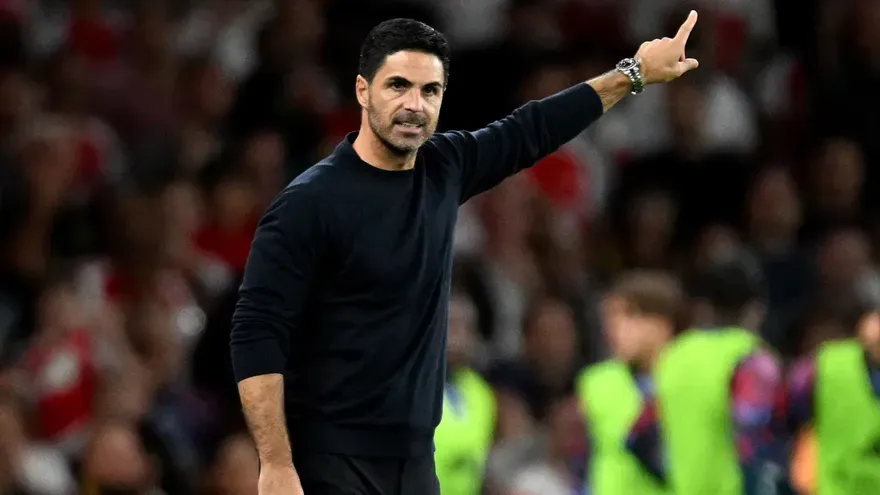
Arsenal have already enjoyed a terrific transfer window, adding major quality across the squad with the arrivals of Christos Tzolis, Bruno Guimaraes and Ezri Konsa, among others. The final piece of Mikel Arteta’s puzzle could now be Julian Alvarez. The Argentine reportedly prefers Barcelona, but Atletico Madrid have repeatedly made clear that they are unwilling to facilitate a move to their Spanish rivals, while Arsenal remain interested in signing him. If Alvarez does eventually arrive at the Emirates, Viktor Gyökeres could become the major casualty, potentially leaving Arsenal after only one season. In that scenario, Arsenal’s primary striker options would be Kai Havertz and Alvarez.
Arteta Has Already Sent Gyökeres A Message
There is already growing evidence that Gyökeres may not be at the centre of Arteta’s plans.
The clearest message came in the Community Shield against Enzo Maresca’s Manchester City, when Havertz was selected ahead of the Swedish striker. Arsenal went on to win 3-0, with Havertz himself getting on the scoresheet alongside Riccardo Calafiori and Martin Ødegaard.
Then came the Premier League opener against Frank Lampard’s Coventry City, and the situation became even more striking. Havertz once again started ahead of Gyökeres, while the Swedish striker did not even come off the bench during Arsenal’s 3-0 victory.
That is arguably the biggest message Arteta could have sent.
To make matters worse for Gyökeres, his direct replacement Havertz scored in both matches, while Arsenal themselves looked exceptionally strong in both games. Arteta therefore has very little reason to change a formula that is already producing excellent results.
Gyökeres vs Havertz vs Alvarez: What Does Arteta Actually Want?
The biggest reason Arteta appears to favour Havertz, and potentially sees Alvarez as an upgrade, is not necessarily because one player is dramatically better than the others.
It is about what type of striker Arteta wants in his system.
Gyökeres is an exceptional striker, particularly when he can use his physicality, explosiveness and direct running to attack space. However, his first season at Arsenal made one thing increasingly clear: Arteta's system does not necessarily maximise the natural strengths of a traditional, physical, poacher-style No. 9.
Arteta wants his centre-forward to do much more.
He wants a striker capable of dropping into midfield, linking play, pressing aggressively, contributing defensively and constantly interchanging positions with the attacking players around him. The centre-forward is expected to be part of Arsenal's overall positional structure rather than simply occupying the penalty box and waiting for chances.
This is where Havertz and Alvarez become particularly attractive.
Both are versatile forwards who can drift away from the traditional No. 9 position, participate in build-up play and contribute significantly without necessarily being the player finishing every attack.
That compatibility with Arteta's football could ultimately be more important than pure goalscoring ability.
Why Julian Alvarez Is Perfect For Arsenal
Alvarez could be almost tailor-made for Arsenal's attacking system.
The Argentine possesses the pressing intensity Arteta demands, the technical ability to combine with teammates and the intelligence to move between positions. He can operate as a central striker, play behind the main forward or drift into wider areas when required.
But there is another major reason why Alvarez makes sense for Arsenal: consistency and availability.
Havertz is arguably the dream forward for Arteta because of his versatility and tactical intelligence. However, his injury history represents a significant concern. Arsenal cannot afford to build their Premier League and Champions League campaigns around a forward who may repeatedly spend important periods unavailable.
That is where Alvarez becomes so valuable.
The Argentine offers many of the same characteristics that make Havertz attractive to Arteta, while also arguably providing an even higher level of quality and greater reliability. Since joining Atletico Madrid from Manchester City, Alvarez has already established himself as an elite-level forward, scoring 49 goals in 106 appearances for the Spanish club.
For a manager competing simultaneously for the Premier League and Champions League, having a forward capable of maintaining his level across an entire season is enormously important.
Why Gyökeres Could Be The Odd Man Out
This is what makes the situation so difficult for Gyökeres.
The Swedish striker is not suddenly a bad player. Far from it. His physical presence, goalscoring ability and explosiveness remain enormous assets. But football at the highest level is ultimately about tactical compatibility.
If Arteta believes Havertz and Alvarez provide exactly what his system requires, Gyökeres could find himself competing for a role that does not naturally suit his strongest qualities.
That would explain why a striker Arsenal spent heavily on could potentially become expendable after only one season.
Meanwhile, Alvarez's current situation at Atletico has made an Arsenal move increasingly intriguing. The Argentine has expressed his desire to leave and reportedly prefers Barcelona, but Atletico have remained extremely resistant to selling him to their Spanish rivals. Arsenal therefore represent one of the major alternative destinations if a deal can be reached.
Arsenal's Attack Could Become Even Stronger
Ultimately, Arsenal's forward line remains one of the biggest talking points of the transfer window.
Whether Gyökeres stays or leaves, Arteta has assembled an extremely strong squad capable of competing for every major trophy. If Gyökeres remains, Arsenal retain a powerful physical No. 9 who can offer something different. If Alvarez arrives instead, Arteta could have two forwards in Havertz and Alvarez who are almost perfectly suited to his tactical philosophy.
The fascinating part is that this is not necessarily a case of Gyökeres being inferior to Havertz or Alvarez.
It is about being the right fit to Arsenal's playing style.
And if Arteta ultimately chooses Alvarez over Gyökeres, it will likely be because the Argentine represents the type of forward he believes can take Arsenal's positional football to another level.
The summer transfer window is not over yet, and Arsenal's final forward line remains uncertain. But one thing is already clear: whether Gyökeres stays or leaves, Arteta's Arsenal remain an exceptionally strong side capable of winning the Premier League, Champions League and all the major titles.